
Permits
Where Can a Dumpster Actually Go in Rochester?
The paperwork here is simple. The seasons are the complicated part.
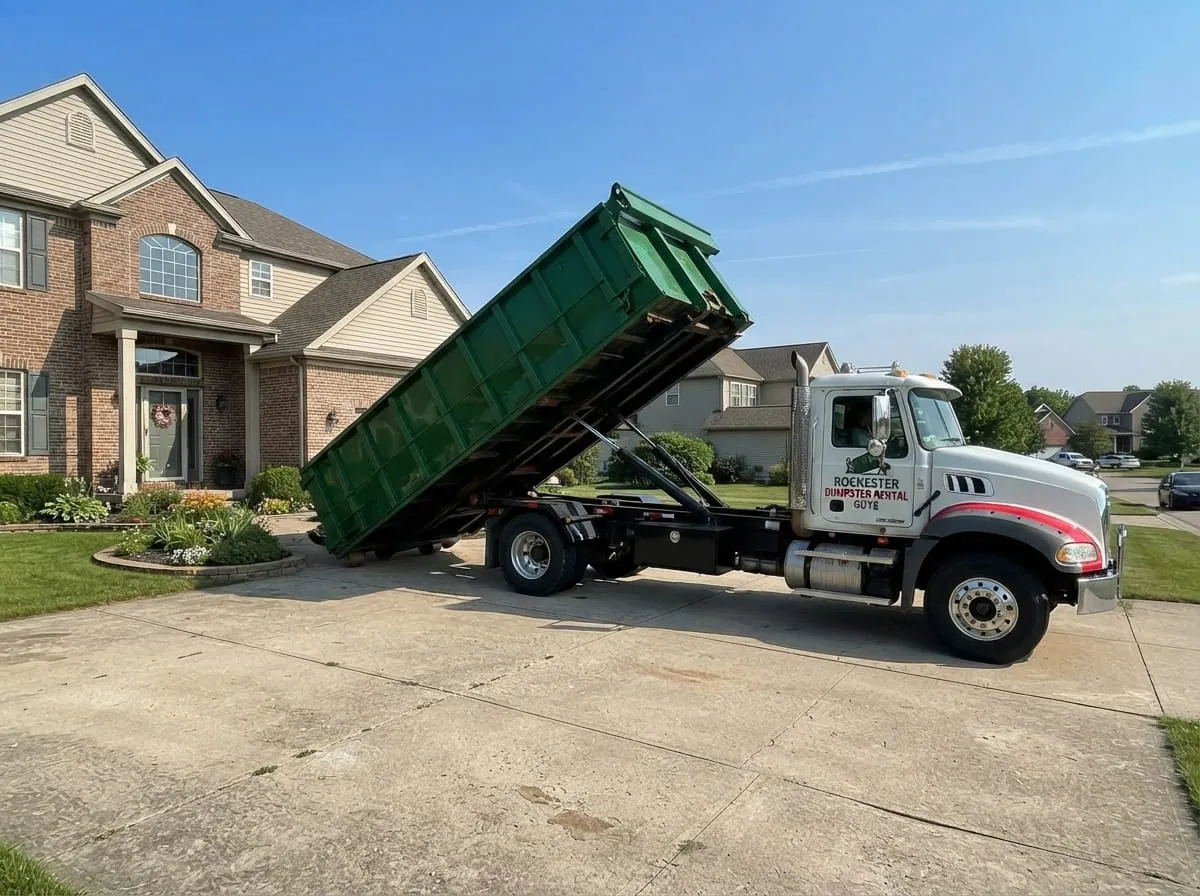
The short answer
If a temporary roll-off is going on your own driveway or private lot for the duration of a project, you are almost certainly fine without a placement permit.
If it has to sit on a public street, ask first — and ask us, because we work across seventeen communities in six counties and can point you at the right office.
Most of this market has real driveways and room to work, which makes placement genuinely easier here than in many of the places we have worked. The complications are seasonal rather than spatial.
Private property: a temporary roll-off
A driveway, a private parking area, a fenced site or a commercial lot you own or lease is private property, and a temporary container placed there for a project is not what municipal placement rules are aimed at.
Two caveats that are not placement permits but behave like them:
- The underlying work usually needs a building permit.
- If the property is a rental or has an association, their permission is not optional. Get it before you book rather than after.
Street placement: ask first
Rules for containers in the roadway are set by each municipality individually, and we would rather you asked than assumed.
Two practical points beyond the paperwork. Arrange it properly rather than hoping, and keep the period short. ⚠️ In this market there is a third: a container on the street in winter is in the way of snow clearance, which municipalities take seriously and plough crews take personally. If the work can wait for spring, it usually should.
⚠️ Frost, thaw and what the ground will carry
This is the part that differs most from warmer markets, and it changes through the year.
- Frozen ground carries a loaded container well. Deep winter is actually a good time for placement on a gravel or grass surface.
- ⚠️ Spring thaw is the worst time. Ground that was solid in February turns soft, and an asphalt driveway is at its most vulnerable while the base underneath is still saturated.
- Tell us the surface — asphalt, concrete, gravel, grass. It changes what we do.
- We put timber boards down on every delivery regardless, and on asphalt in spring we will use more of them.
- Soft gravel after rain is a genuine problem for a loaded truck, not a theoretical one.
If you are planning a project around the thaw, tell us the dates and we will tell you honestly whether the placement spot is a good idea.
⚠️ Snow and winter placement
We deliver all winter. A few things make it work:
- Clear and salt the placement spot before delivery. A truck cannot set a container down accurately on sheet ice.
- Clear a path to it too, or loading becomes miserable and people start leaving material beside the container instead of in it.
- Tell us about any grade. A slope that is fine in September is a different question with ice on it, and a loaded container on an icy incline is a genuine safety matter.
- Keep snow out of the container. ⚠️ Snow and ice are weight, and you pay for weight. A container left open through two storms can collect a surprising amount.
- Material freezes together. Wet carpet, soil and plaster will become one mass that has to be broken out at the other end.
- Book shorter windows in winter — fill it and let us take it.
Overhead wires and the tipping arc
Easy to forget, because the container is low and the problem is high.
A roll-off truck raises the bed steeply to set a container down and to pick it up, and needs clear height well above the container itself.
- Overhead service wires to the house
- Low branches, which in this market are often heavy with snow or ice
- Garage door openers, basketball hoops and porch roofs near the placement spot
- Carports, which are the one people forget entirely
Tell us about anything overhead. It is the most common cause of a wasted trip after the surface itself.
⚠️ Six counties, and why it matters
Placement rules are municipal, but something bigger changes with the county line here.
- Olmsted County — Rochester, Byron, Stewartville, Eyota, Dover, Oronoco. Waste originating here must go to Olmsted County facilities.
- Dodge County — Kasson, Mantorville, Dodge Center, Hayfield
- Goodhue County — Pine Island, Zumbrota, Wanamingo
- Winona County — St. Charles
- Fillmore County — Spring Valley, and part of Chatfield
- Wabasha County — Elgin, Lake City
⚠️ Chatfield straddles the Olmsted and Fillmore county line, so confirm which side your address is on. ⚠️ And Dover sits right against the eastern county line too.
What does not change with the county is Minnesota state law — the yard waste, television and appliance bans apply at every address in the state.
What we need from you
- Whether the container is going on private property or the street
- The surface — asphalt, concrete, gravel or grass
- ⚠️ Any grade, and whether there is ice or snow on it
- Anything overhead — wires, branches, a carport
- Driveway width and length
- Whether there is a landlord or an association, and whether you have asked them
- ⚠️ Which town and which county
- Whether the underlying work is permitted
We cannot pull street permission for you — it attaches to the property owner or the contractor — but we work across all of these jurisdictions and can make sure you ask the right office first time.
Ordinances vary by municipality and change over time, and this service area spans six counties. The above reflects how these jurisdictions generally operate at the time of writing. For anything consequential, confirm with your own city or county office.
Need a container in Rochester?
Call and describe the job. Three minutes on the phone gets you a size recommendation, a flat rate and a delivery window — and we will tell you if a smaller, cheaper container is the right answer.
Call (507) 516-5784